> For the complete documentation index, see [llms.txt](https://docs.mindkosh.com/llms.txt). Markdown versions of documentation pages are available by appending `.md` to page URLs; this page is available as [Markdown](https://docs.mindkosh.com/management/datasets.md).
# Datasets
Use datasets to manage your raw data.
All your raw data - including images, point clouds and videos are managed through datasets. You can add tags to each file in your dataset to organize it into different subsets.
To create a dataset, select what type of data you would like to upload, and where you would like to upload it.
You can upload data to your datasets multiple times. [**Check out this guide**](/management/datasets/uploading-data.md) **to see the different ways in which you can add your data to Mindkosh.**
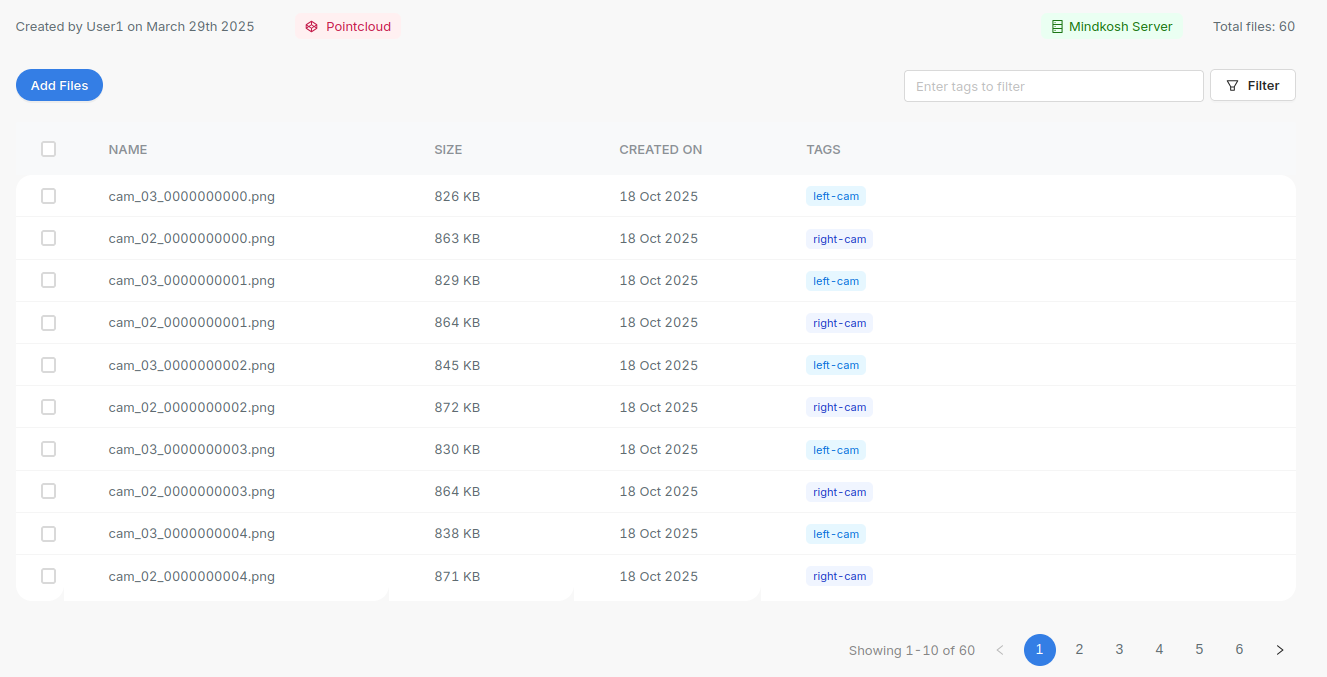
Once uploaded, you can see it in a list and filter by tags.
{% hint style="info" %}
To start labeling this uploaded data, you need to create a task and attach a dataset to it. [Check out this guide](/management/tasks.md#creating-a-new-task) to see how you can create a task.
{% endhint %}
### Using tags
Tags are a great way to organize your data on Mindkosh. For e.g. if you have multi-modal data, you can tag the data from each sensor with a specific tag to easily identify it.
{% hint style="success" %}
You can add multiple tags to each file
{% endhint %}
Another way to tags is to segment your data in meaningful ways. For e.g. imagine that you are uploading data captured on specific days. You could tag the data from each day with a specific tag, to easily identify the files captured on a particular day. These tags can then be used to label data from specific days in separate tasks.